
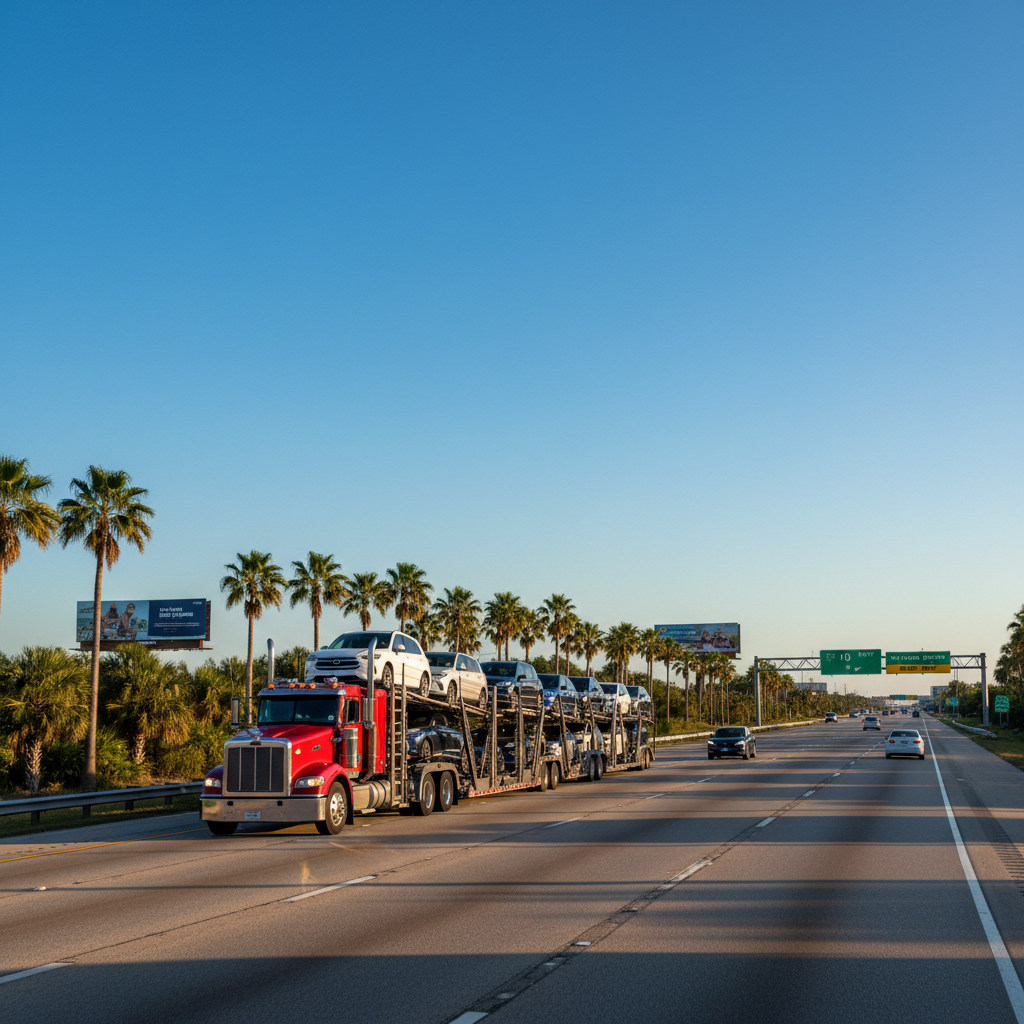
The Florida-to-Texas lane connects two of the fastest-growing states in the country, and the traffic runs in both directions: retirees and remote workers settling in Texas, Floridians relocating for jobs in Houston and Dallas, and a constant current of seasonal residents moving between the two. Miami to Houston runs roughly 1,200 miles down the I-10 corridor; Orlando to Dallas-Fort Worth is similar.
Because the route is well-traveled and corridor-friendly, pricing is competitive by regional standards. What makes this lane unique is seasonality — and understanding it is the difference between booking at a good rate and paying a premium for the same truck.
The corridor: I-10 and a deep carrier pool
Most Florida-to-Texas shipments follow I-10 through the Panhandle — Jacksonville, Tallahassee, Pensacola, Mobile, Baton Rouge, Houston — with DFW shipments branching north. Endpoints near the corridor price better than endpoints far from it: a vehicle moving from suburban Tampa to suburban Houston prices differently than one originating in the Florida Keys, where carrier access is limited.
The lane's heavy traffic means carriers rarely run it empty in either direction, which supports competitive pricing and short pickup windows for most of the year. The exception is the seasonal swing — and in this corridor, the seasons matter enormously.
Snowbird season shapes everything
From roughly October through April, demand to move vehicles south into Florida surges as winter residents arrive — and the return flow north builds from March through May. Florida-to-Texas sits in the middle of this pattern: during peak southbound months, carriers heading into Florida are full, and vehicles moving out of Florida to Texas can be very well-priced because carriers want balanced routes and southbound-paying loads.
The takeaway is practical, not theoretical: the same shipment can price noticeably differently depending on the month. If your timing is flexible, ask your coordinator which window currently favors your direction. If it isn't — a lease ending, a job starting — book early, because peak-season capacity on popular corridors is claimed weeks in advance.
What your quote reflects
On a corridor this competitive, the major cost variables are your specific endpoints, your vehicle's size, the season, and open versus enclosed. Open transport is the standard choice for daily drivers on this route — the distance is moderate, exposure is limited to a few days, and open capacity is deep. Enclosed earns its place for collector cars, recent paint work, and exotics, and Florida's sun and afternoon storms make the protection argument easy to understand.
As with any route, beware quotes that seem detached from market reality. A rate far below the competitive field usually means a broker underbidding to win the booking — and the predictable result is a delayed pickup, not a bargain.
Timing and transit windows
Door-to-door transit for Florida-to-Texas shipments typically runs three to six days, including the pickup window. In off-peak months, pickup often happens within a couple of business days of your scheduled date; during the height of snowbird season, build in a little more cushion and book further ahead.
One to two weeks' notice is the comfortable standard for open transport; two to four weeks is ideal for enclosed, especially October through April. Hurricane season (June through November) occasionally compresses capacity in Florida — after a storm, carriers get pulled toward recovery logistics, and normal schedules tighten until routes stabilize.
Getting the car ready
Preparation is simple but worth doing right: about a quarter tank of fuel, no loose items in the cabin, toll transponders removed or wrapped, and a charged battery. A wash before pickup makes the condition report at both ends more accurate — small effort, real protection.
If the car is registered in Florida and you're making the move permanent, remember that registration and insurance changes are your side of the move — the transport itself requires no registration changes, only the keys and a signed Bill of Lading at each end.
Shipping with NTS on this route
We run Florida-to-Texas shipments year-round and plan around the seasonal curve rather than being surprised by it. Every shipment gets a firm, all-inclusive quote, access-confirmed door-to-door pickup and delivery, and a dedicated coordinator who tracks the load from dispatch to final signature.
"On a corridor this busy, the best rate isn't the lowest number you'll find — it's the one that comes with a truck that shows up on schedule, in season and out."